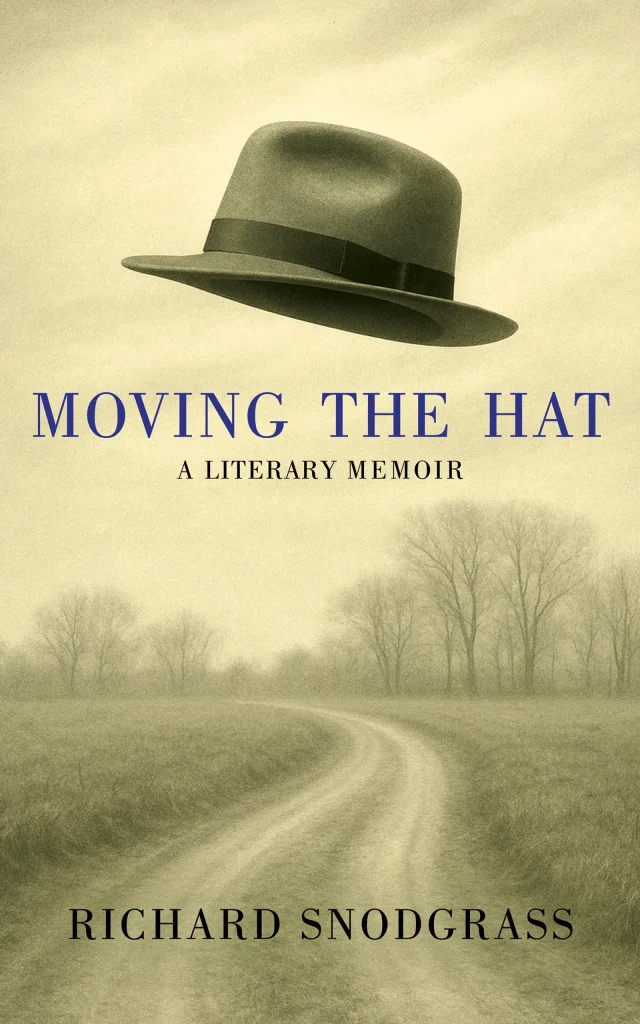
Richard Snodgrass’ memoir, Moving the Hat, retells the classic struggle of a younger brother working to establish himself in his life and his art against the psychological bullying of a troubled, domineering older brother, the poet W.D. Snodgrass. Through interweaving prose and photographs, Moving the Hat tells the story of Richard as a young adult, a journey that saw him through the beginnings of becoming a monk; graduate from UC Berkeley at the height of the Free Speech Movement; spend several years in the music and hippie scene of San Francisco; followed by a dozen years as a construction inspector on high-rise buildings—all the time continuing to write three to four hours a day and master his photography. Then in his mid-thirties as he came into his own, he returned across the country to devote himself to his art, as well as confront his feelings about his brother, and his brother’s young wife. With Richard’s photographs in counterpoint to his story, Moving the Hat is a unique portrait of the making of an artist, told with insight, wit, and a life-affirming pursuit of balance.
View the other series of Richard Snodgrass’ fine art photography.

Here’s What They’re Saying About MOVING THE HAT
This is a fantastic memoir, both compelling and absorbing, and demonstrates to the full Richard Snodgrass’s skill at writing clearly, accessibly and with great insight. It’s a very personal and comprehensive memoir, told with honesty. He explores the pitfalls of growing up in the shadow of his famous older brother, the poet W D Snodgrass, and how he manages to come out from under his influence.
He chronicles his varied career, including the all-important period working in the construction industry, which formed the basis of his excellent Furnass series of novels. Conversations with his wife are included in the memoir, adding another thoughtful layer to the narrative, and some of his own evocative photographs are interleaved with the text to great effect.
I have been an avid reader of Snodgrass’s novels for many years, and found this memoir so enlightening. I simply don’t understand how such an accomplished writer isn’t better known and acclaimed. His novels are so good – why isn’t his name on everyone’s lips? Where are all the reviews? Through the memoir I discovered his debut novel There’s Something in the Back Yard, a largely undiscovered gem, which I proceeded to read with enormous pleasure. So whether you read the memoir or the novels, or preferably both, Richard Snodgrass is a writer whom you really should get to know. You won’t regret it.
– NetGalley
In this second volume of memoir (after The House with Round Windows), Snodgrass explores his family strengths and challenges, from their foundational influence on his life and art to the cracks that undermined their happiness—cracks widened, he states, by his older brother, acclaimed poet W.D. Snodgrass. After trying several times to pin down that relationship, Snodgrass, now 84, is finally ready to move on. With a sentimental, chummy style, he recounts his life under his brother’s long shadow, coming to the conclusion that the most important story is “how I’ve tried to establish myself as a person without him, or maybe despite him, and become an artist in my own right.”
An accomplished photographer keenly interested in multimedia storytelling, Snodgrass skillfully fuses his twin talents here, pairing monochromatic images with vivid prose. This results in a powerful emotional effect, as when his dark portrait series of old toys is set alongside passages that recount wholesome childhood memories, or his stark recollection, paired with joyful family photos, of how his beloved sister Barbara died unexpectedly at age 27, “leaving those who were left to shift back and forth in compensation, try to achieve some stability, a balance that would never be found again.”
Readers will sense the disturbances that marked the author’s coming of age, those moments when he grew insecure in his own memories and unsure of whom in his family he could trust. He anchors those stories to a unique framing device, casting his wife, Marty, as an audience of one, seemingly listening to the book as it’s being written. She frequently interrupts his reminiscences with an editorial perspective from the present day; the result is sometimes funny and sometimes jarring, but fits the book’s theme of finding balance, of looking back over a life composed of “light and dark, right and wrong, each providing the opposition to define the other.”
Takeaway: Striking multimedia exploration of family, legacy, and self.
– BookLife Reviews
In Moving the Hat, Richard Snodgrass masterfully weaves autobiography and fine art photography into a saga whose dark moments are equaled by sharp-witted humor. The book is like a shoebox found tucked away on a shelf, its treasures waiting to be opened and explored.
– JOANNE LEONARD
Author and Photographer, BEING IN PICTURES.
Professor Emerita of the School of Art and Design and Department of Women’s Studies,
University of Michigan, Ann Arbor
A comprehensive and unflinching glimpse at a humble but extraordinary life, Richard Snodgrass’s MOVING THE HAT hums with honesty and hard-earned wisdom.
Stirring, vulnerable and unexpectedly relatable, Moving the Hat by Richard Snodgrass is a deeply personal memoir that pulls back the curtain on the author’s pursuit of an artistic life, despite unusual challenges faced and emotional baggage borne.
Beginning with his early years and teenage steps toward a purposeful existence, Richard Snodgrass invites readers into the scrapbook of his most intimate memories: MOVING THE HAT. Many of these reflections are dominated by “De,” his older brother—a prodigiously talented poet, teacher, and social climber who “provided an example of how to live.” However, the fraternal idolization had its darker sides, including Richard becoming subject to untrained psychoanalysis and manipulation that affected his ability to move through the world and trust himself or others. While Richard eventually moved past those experiences to become a colorful and unpredictable adult, the specter of that destabilizing betrayal remained.
Whether overcoming the psychological sabotage of his formative years, discovering his aversion to monastic life, navigating Berkeley’s hippie haven in the early 60s, or sneaking in graduate studies between construction site inspection visits, Snodgrass details the minutiae of his life with unironic pride and journalistic rigor. His unwavering belief in himself and his capacity to enjoy an extraordinary life is striking, juxtaposed sharply against his free-wheeling beliefs in other areas (from religion and romance to cultural norms and independence). The final section of the book is the most revelatory: after he returns home to face the hard truths of his family, even as parent-child roles switch, giving him ample space for grace and catharsis.
The artist’s journey is a well-worn path in plenty of genres, but Snodgrass avoids lofty or worldly wisdom delivered from on high; he merely shares with readers the special character of his life and times, the highs and lows, the happiness found and loves lost. Granted, there are some moments of philosophical insight and indirect advice on “best practices” in life, but they arrive in organic and authentic ways—such as the realizations about his family that lead him to uproot and return to the East Coast on his “Dance with the Dragon” road trip. The occasional present-day interludes with him and his wife add even more depth and warmth to the reading experience.
The photographic accompaniment to this decade-spanning story is idiosyncratic to say the least, demonstrating the author’s inquisitive eye and his non-traditional style as a visual artist. Some of the pieces feel more apropos in the narrative than others, but the curation is thought-provoking and diverse. There is a refreshing bluntness to Snodgrass’s storytelling—a matter-of-fact style that showcases his remarkable powers of reflection and humble self-knowledge. That said, he doesn’t always show editorial discernment between tangent and treasure, making some of the recollections more meandering than meaningful.
Nevertheless, for readers who have struggled with their own internal and familial dramas along the road of life, this emotionally engaged memoir resonates with honesty and encouragement.
A comprehensive and unflinching glimpse at a humble but extraordinary life, Richard Snodgrass’s MOVING THE HAT hums with honesty and hard-earned wisdom.
– IndieReader
An unpredictable and intimate saga of self-discovery, healing, forgiveness, and ambition, Moving the Hat by Richard Snodgrass is a stunning piece of personal revelation and humanistic wisdom.
From growing up in small-town Pennsylvania and scraping by in Berkeley’s hazy utopia of the early 1960s to working as a construction inspector delivering bad news to rough men, and reinventing his own life as an inimitable artist, readers are brought into the nuanced everyday drama of the author’s carefully observed life. As Snodgrass eases readers into the structure and mindset behind the book itself, Snodgrass makes it immediately clear that this will not be a memoir like many others; the quality of authentic conversation between reader and writer is undeniable from the start, while the internal intimacy of the narration makes the reading experience vulnerable, uncensored, and boldly voyeuristic.
The first half of the book covers formative years and the foundational divides in his family, many of which relate to his Pulitzer Prize-winning brother, “De,” and the poetic pain points of art and fame. The author’s brother was “central to [his] early education and thinking,” but also an oppressive and challenging personality who overshadowed his days and diminished his ambitions in myriad ways. The imbalance of his older brother’s ego and allergy to criticism dominated their relationship, deeply affecting Snodgrass’s views of his own future, even as he doggedly pursued artistic freedom and emotional validation in new forms and unexpected career paths.
Stories of brotherly rivalry and the interwoven strife of that dynamic are both old and familiar, yet they ring a compelling fraternal bell that never tires; Snodgrass and his renowned sibling follow in a long tradition of complexity, blood, and competition, but there is also much more to this memoir than a reincarnated archetype. There are anecdotes that reveal the visceral experiences of sexual exploration, peer pressure, tough love, impostor syndrome, familial caretaking, raw grief, and the growing pains of each new generation. The final season of this story, in which he reconnects with his mother at the end of her life, demonstrates the depth of his personal growth and expanded capacity for empathy.
A real-world sojourn through memory to which readers of every stripe and circumstance will relate, this is a neatly crafted chronicle that leans towards the light without shying away from the darkness. The author’s moments of candid reflection and philosophy are subtly woven into personal narratives, allowing him to swing freely from the personal to the universal, but achieving fluidity with metaphorical ease and a conversational tone. Having already published a number of deeply felt works of fiction, Snodgrass has developed an obvious comfort with confession, and sagely dissects his own emotional spaces and shadowed corners with practiced authority.
In the first quarter of the book, there are some scenes of nostalgia that get bogged down in detail, but the overall curation of memories is well-paced and balanced. On a somewhat similar note, the photographic accompaniment of the memoir ranges from beautifully composed to repetitive or unclearly linked. Snodgrass has a good eye and a clear passion for photography, but some of the layout, ordering, and formatting work could be better organized.
Those small criticisms aside, Snodgrass elegantly captures an essential snapshot of his own life, paying homage to his changing passions, unwavering nature, and steadfast belief in the ability to heal, armed with a stirring capacity for self-revelation.
– Self-Publishing Review
Moving the Hat describes the lifelong struggles of Richard Snodgrass to live his own rather remarkable life despite the deep, troubling shadows cast by his older brother, the Pulitzer Prize-winning poet, W.D. Snodgrass. Wonderful story; captivating photographs.
– John Balaban, National Book Award nominee and author of the 2024 Passing Through a Gate, poems, essays, and translations.
In this memoir, Snodgrass discusses his artistic journey in the shadow of his famous brother.
The Snodgrasses were one of the more prominent families in the Western Pennsylvania mill town of Beaver Falls—the author’s father was a successful accountant, and his mother was president of the school board and regent of the local chapter of the Daughters of the American Revolution. The most influential person in Snodgrass’s early life, however, was his older brother, De, better known to the literary world as the Pulitzer Prize–winning poet W.D. Snodgrass. “It was De, as an older brother will, who provided me an example of how to live,” writes the author. “Which was ironic because he left for the service when I was four…It is doubly ironic because it seems De hated me.” It was De who, during a weekend visit that would have life-long ramifications for the younger Snodgrass, staged a psychic intervention to convince the then-teenage author that his parents were attempting to smother him to death with love (a claim that had some resonance, given the recent death of their sister).
Richard Snodgrass’ adolescent passions for jazz drumming and photography competed with an intense infatuation with Roman Catholicism, introduced to him by his high school girlfriend. A Jesuit college in Detroit broke him of his religiosity, and Snodgrass transferred to Berkeley and devoted himself to writing. Living in San Francisco after graduation, Snodgrass was immersed in the music, art, sex, and politics of the 1960s while working an unexpectedly fascinating job as a concrete inspector for high-rise buildings around the city. It was not until his 30s, with one failed marriage under his belt, that he decided to set out on a trip to fulfill two long-standing desires: to commit himself to art photography and to gain closure with his famous older brother—even if that closure took the form of sleeping with De’s wife.
Snodgrass’ penetrating prose captures the people around him in sharp detail. He describes a time when he and his skeptical first wife, Carol, visited De and his wife, Camille, while they were living in a farmhouse near Syracuse: “They met us after dark at a crossroads to lead us along the country roads…Carol bristled as Camille hugged her, called her ‘Sister-woman.’ De, in a full beard, was looking like an Orthodox priest; he reached out to hug Carol but she waved him away.” Each page of text is counterposed with a black-and-white photograph; some are biographical, but most are examples of Snodgrass’ art. They include pictures of old toys—teddy bears, tin soldiers, tops, doll houses—whose well-worn exteriors and decades-long abandonment complement the memoir’s impulse to sift through material from long ago. The narrative is episodic, divided into chunks that fit cleanly on each page (the author reveals early on that one potential title for the book was Snippets of a Snodgrass). While the story lacks a dramatic shape, it manages to capture insights about an artistic life—the many false starts and fallow periods, the personal rivalries, and the urge to look ever backward for the place where roads diverged.
A meandering but reliably rich memoir of an artist and his maturation.
– Kirkus Reviews